TRADITIONS
Nativity Scenes in Italy
It all started in Italy, and Italians have loved the nativity scene ever since. From the hill village near Umbria where Saint Francis of Assisi set up a manger in 1223 to the street in Naples where new figures go on sale every December, the presepe is still very much part of everyday life, not a museum piece.
Presepe, presepio
Italians use both words. Presepe and presepio both come from the Latin praesaepe, meaning a pen or a manger, just like the French crèche and the English “crib.” Which one you hear depends on the region. They mean the same thing.
The word covers everything from a small nativity at home to the huge displays in churches and museums. See the glossary.
Greccio
The village of Greccio, in the province of Rieti (Lazio), is where the Christmas of 1223 described by Thomas of Celano took place: a manger filled with straw, a live ox and donkey, and Mass celebrated for villagers who came carrying torches. Read the full story.
A Franciscan shrine now stands on the spot, and the village reenacts that night every Christmas season. It’s one of the few living nativities in the world that can trace a direct line to where it all began. But nothing from that night survives. The oldest nativity scenes still standing are elsewhere in Italy, and more than one claims the title. See what is the oldest nativity scene in the world.
Naples
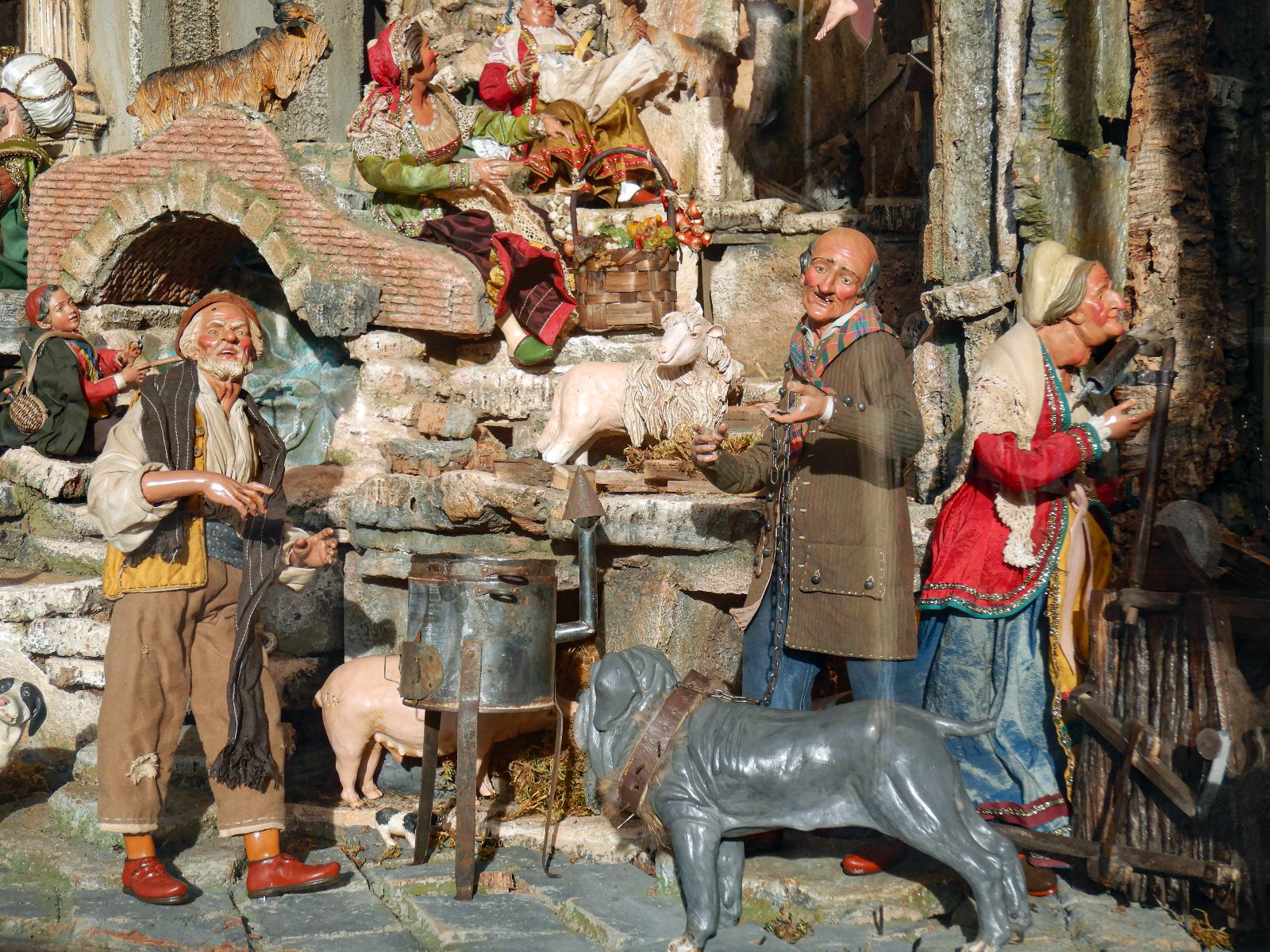
The Neapolitan presepe is the most spectacular style of all, and it has its own how-to page. Here’s what to know about the tradition. (The Maltese nativity grew directly out of this style, by way of Sicily: see the nativity in Malta.)
- The 18th century was its golden age. Under the Bourbon kings, the nativity scene became a true art form, and noble families hired famous sculptors to make them.
- Everyday life takes center stage. A tavern, a market, musicians, beggars. The birth of Christ happens right in the middle of ordinary life, which is the whole meaning of the Incarnation: God came into our everyday world.
- Via San Gregorio Armeno in Naples is still lined with workshops. You’ll find the traditional figures there and, every year, new ones of people in the news: athletes, singers, politicians. That’s not a modern gimmick. Neapolitan nativity makers have always put the people of their day into the scene. For the Naples workshops and the Bologna fair, see nativity fairs in Italy.
- The great public collections, especially the San Martino museum in Naples, have 18th-century displays that show just how grand these scenes can be. In the United States, the Metropolitan Museum of Art in New York sets up its Neapolitan Baroque crèche around a Christmas tree every December, a tradition since 1957. For these museums and other places to see a nativity, see where to see nativity scenes in Italy.
The other schools
There’s more to the Italian presepe than Naples. Other regions have their own styles, and they’re all still going strong:
- Sicily: a long tradition of nativity scenes made from all kinds of materials, including coral, alabaster and wax, plus many living nativities in its towns.
- Liguria: carved wooden figures in a style all its own.
- Trentino-South Tyrol: Alpine woodcarving in the German tradition, very close to what you see across the border in Austria. Val Gardena is famous for its carvers.
- Bologna: a long city tradition, with its own Christmas fair just for nativity figures.
That’s what Italy and Provence have most in common: in both, the nativity scene belongs first to the town or region, then to the country.
Calendar customs
- The bambinello, the Baby Jesus, is laid in the manger at midnight on Christmas Eve. As almost everywhere, the manger stays empty until then. The meatless Christmas Eve dinner, the Vigilia, is where the Italian American Feast of the Seven Fishes comes from.
- The Three Wise Men arrive on January 6. Many families move them a little closer to the stable each day of the twelve days of Christmas.
- Epiphany is also the night of the Befana, a kindly old woman from Italian folklore who brings treats to children. She isn’t part of the nativity, but she shares the date.
- Taking it down usually happens after Epiphany, sometimes not until Candlemas (February 2).
The presepe vivente
No country has more living nativities than Italy. Hundreds of villages put one on during the Christmas season. Local people play the roles, old trades come back to life for the occasion (the blacksmith, the bread oven, spinning), and visitors walk through a village turned into Bethlehem.
It’s a community event first and a show second, and that’s what makes it so close to the spirit of Greccio. See our page on living nativities.
Dates, places and sizes change every year, so we don’t list them here: any list would be out of date by next Christmas. Check with local tourist offices.