SYMBOLISM
Greccio, 1223
A cave above a village in the Rieti valley, a manger filled with straw, an ox, a donkey, and villagers carrying torches. There were no figures, no scenery, no carved Holy Family, and yet everything on this site goes back to that night.
The story
It’s Christmas night, 1223. Saint Francis of Assisi is staying near Greccio, a village in the Rieti valley, in today’s Lazio region, on the border of Umbria. He asks a local man (tradition calls him John of Greccio) to set up a manger filled with hay for the night, and to bring an ox and a donkey.
That evening, the friars and local people arrive with candles and torches. Mass is celebrated right there, with the manger serving as the altar. Francis, who was a deacon and not a priest, chants the Gospel and then preaches to the crowd about the birth of the poor King.
According to the account, one man there saw a child lying in the manger, who seemed to wake as Francis came near. The source presents it clearly as a vision.
Where Greccio is
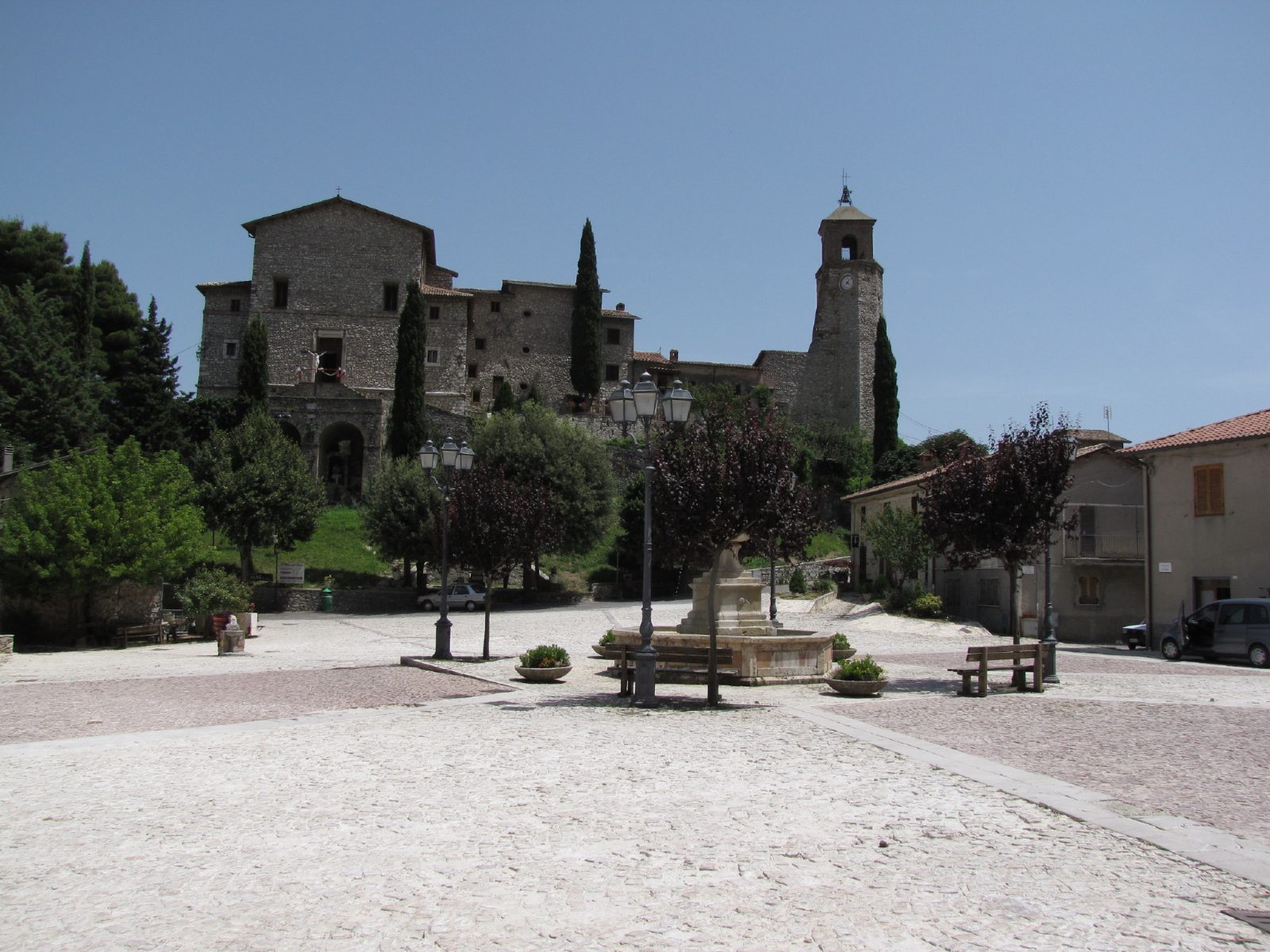
Greccio is a hilltop village in the province of Rieti, in Lazio, on the border of Umbria. It’s about 10 miles from Rieti and about 60 miles northeast of Rome by road. Assisi, Francis’s hometown, is farther north, in Umbria.
The shrine is about a mile from the village, at about 2,180 feet (665 m). It’s the best known of the four Franciscan shrines in Rieti’s “Holy Valley,” along with Fonte Colombo, Poggio Bustone and La Foresta, which are now linked by the Way of Saint Francis walking trail. See Greccio on OpenStreetMap.
The source
We know about that night from Thomas of Celano, Francis’s first biographer, who wrote his First Life soon after the saint died in 1226. He wasn’t at Greccio himself, but he wrote just a few years later, for readers many of whom knew people who had been there.
Here’s what we can say for sure: there was a Christmas celebration at Greccio, around a manger, with animals and local people, and it moved people so much that it was written down.
Celano also sums up the night in a famous line: “Greccio was made, as it were, a new Bethlehem.” For the real Bethlehem that pilgrims visit today, see the Holy Land page.
What it doesn’t say is that Francis set out to do something new. It was later generations who saw it as the beginning of a tradition.
What Francis wanted
Celano is clear about why: Francis wanted people to feel the poverty of Christ’s birth. To see with their own eyes how uncomfortable it was for a newborn to lie in an animals’ feeding trough, to feel the cold, to hear the animals.
He was teaching through real things, to people who knew stables and winter nights better than anyone. It wasn’t about illustrating a Bible passage. It was about helping people live it.
Ever since, that goal has been the quiet test of every good nativity scene. See the common thread of poverty.
What was new
Pictures of the Nativity weren’t new: they had existed for a thousand years, on stone coffins, frescoes and manuscripts. But three things were new at Greccio:
-
Three dimensions
A real, life-size scene you could stand in, not a flat picture to look at.
-
The onlooker inside
The people weren’t looking at a picture. They were standing in the scene, in the cold, with the animals.
-
A change of place
The scene left the church and moved into a cave on the edge of a village, among the people who lived there.
Those are exactly the features of a living nativity today. And they’re also what you create when you build a nativity at home: a space, a point of view, and a special place in your house.
What happened next
The custom spread quickly among the Franciscans, and then beyond. Over the next two centuries, live animals gave way to carved figures, and the scene moved from the cave into the church. That was the start of church nativity scenes, in wood or clay, sometimes life-size. The oldest surviving nativity scenes come from those churches, not from Greccio: nothing from the night of 1223 was left to keep.
It wasn’t until 18th-century Naples that the scenery itself became an art form, and the French Revolution that brought the nativity into homes on a large scale, with the invention of the santon. See the full history.
So there are eight centuries between a manger in a cave and a 3-inch figure on your dresser, and you can trace the line all the way.
Provençal santon makers haven’t forgotten him either: the monk in a rough brown robe is a familiar figure in the crèche.
Greccio today
A Franciscan shrine now stands on the site, built against the cliff above the village. Visitors can see the chapel built on the spot where, by tradition, it all happened.
During the Christmas season, the village puts on a reenactment of the episode, which makes it one of the few living nativities in the world that can trace a direct line back to the very first one. Dates change from year to year, so check the Valle Santa sanctuaries website. The shrine itself is open all year, and our Italy page covers the visit. In 2019, Pope Francis signed his letter on the nativity scene, Admirabile signum, there: see what the Church says about the nativity.
The lesson, for anyone who builds one
Greccio isn’t just a story about how it all began. It gives you a real test you can use, and that may be the most practical thing on this page.
Here’s the test: a nativity scene that works makes you feel something of the cold, the night and the poverty. One that doesn’t just makes you admire the scenery.
That doesn’t mean you can’t be ambitious or show off your skills: the Neapolitan presepe is anything but modest, and it works. It means the stable itself should stay humble, the lighting should be low and soft, and everything else in the scene should lead the eye to the manger. That idea is behind almost everything we recommend in our DIY guides.
Frequently asked questions
Where is Greccio?
In central Italy, in the province of Rieti (Lazio), on the border of Umbria, about 10 miles from Rieti and about 60 miles northeast of Rome by road.
Who made the first nativity scene?
Saint Francis of Assisi, at Greccio, on Christmas night 1223. We know it through Thomas of Celano, his first biographer.
Were there figurines or statues at Greccio?
No. There was a manger filled with hay, an ox and a donkey, and the villagers gathered around them. Carved figures came later, in churches.
Can you visit Greccio?
Yes. The Franciscan shrine welcomes visitors, and during the Christmas season the village reenacts the night of 1223. Dates change from year to year, so check locally before you go.