STYLE
The Neapolitan Presepio
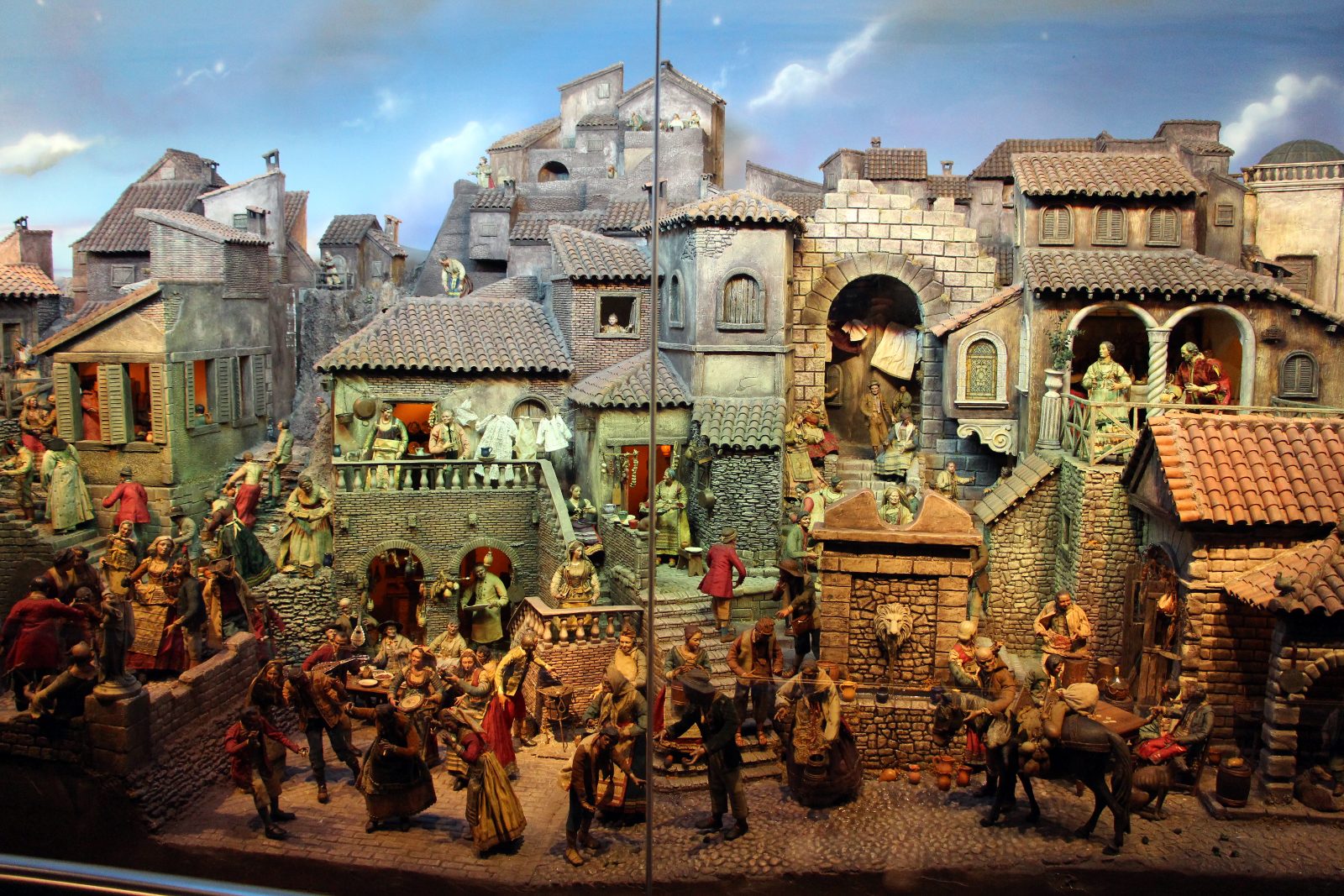
The Neapolitan presepe is closer to a theater than to a simple nativity. It reached its golden age in the 18th century, in a city that loved a show, and it sets the Nativity among ancient ruins, taverns and a busy market, often off to one side. You can see fine 18th-century examples in the US, at the Met in New York and the Carnegie Museum of Art in Pittsburgh: see where to see nativity scenes in the US.
The idea behind the scenery
The ruins are there for a reason. The Neapolitan Nativity is set right on the rubble of the ancient world: broken columns, fallen capitals, collapsed arches. The message is clear: one world is ending and another is beginning, and it begins in the poorest corner of the old one.
The second idea is more surprising: everyday life takes up most of the scene. People eat, drink, sell fish, play music and argue. The Nativity happens right in the middle of it all, and life goes on. It’s the Incarnation, God entering ordinary life, told through stagecraft.
The three required scenes
In the Neapolitan tradition, every complete presepio includes three scenes:
-
The Nativity
In the ruins or the cave, often off-center, sometimes raised up.
-
The annunciation to the shepherds
The angel bursts into view above sleeping shepherds and their flocks. It’s shown as a sudden shock: the shepherds are thrown back, dazzled.
-
The tavern
The osteria: a table loaded with food, the drinkers, the innkeeper. It’s the most down-to-earth scene, and often the most detailed: the cured meats, cheeses and fish are sculpted one by one, in miniature, as carefully as a still-life painting.
There’s often a fourth scene too: the market, with a stall for each trade.
The figures
The Neapolitan pastore (“shepherd,” the word used for every figure, whatever its role) is made very differently from the Provençal santon:
- Head, hands and feet in painted terra-cotta, often finely sculpted, with glass eyes on the best workshop pieces.
- A body of tow over a wire armature (tow is coarse flax or hemp fiber), which can be posed: each figure can be given its own gesture, and that’s the key to the style.
- Clothes in real fabric, cut and sewn, sometimes embroidered. See dressed santons.
- Miniature accessories: baskets, musical instruments, tools, food.
Sizes: usually around 4 to 12 inches, so the scenery has to be big to match. It takes up more room than any other style.
A quirk that’s still alive: every year, the workshops on Via San Gregorio Armeno in Naples make figures of people in the news (athletes, politicians, celebrities) that end up among the shepherds. That’s actually in keeping with the tradition: the Neapolitan presepio has always shown its city as it is right now.
Building the architecture
It’s the hardest style to build, because the scenery is the main event. Three principles:
- Height. The presepio climbs upward. Stairs, terraces, balconies, stacked levels: the eye travels from bottom to top, not left to right.
- Forced perspective. The scenes at the back are built at a smaller scale. It’s a stage-set trick, and it doesn’t hide it.
- Ruins as structure. A broken column should hold something up, like a floor, an arch or a walkway, instead of just sitting there.
The basic technique is the same as for any style: carved and aged foam, as described in the stone wall. This style adds two things: smooth stucco for the grander surfaces, and fake marble made with very watered-down paint washes over a light base.
Light and color
Unlike a Provençal nativity, the colors are rich and bold: deep reds, strong blues, gold, stucco whites. The fabrics add patterns paint couldn’t.
The light is still warm, but more dramatic: strong contrasts, truly dark areas, and several small light sources. The tavern is lit from inside, and so is the Nativity, and between the two it’s night. See lighting.
How to approach it without drowning
A complete presepio takes several years and a lot of space. Two sensible ways to start:
-
A single scene
Build just the tavern, or just the angel appearing to the shepherds, in a 16-inch box. That’s how many workshops sell their pieces anyway: by scene. One finished scene beats a big set that’s barely started.
-
The scarabattolo
A glass case or glass-fronted niche, the traditional Neapolitan way to show a small scene. Tall, deep and lit from inside, it packs the whole style into 12 × 20 inches and keeps dust off the fabrics.
Dressed figures are much more sensitive to light and humidity than clay santons. If you’re going to invest in this style, read caring for dressed figures before you buy, not after.