Places
The Holy Places of the Nativity
Bethlehem, Jerusalem, Nazareth: the places nativity scenes have shown for eight centuries are real, and you can pray there. Here’s what they are, who takes care of them and why, what happens there at Christmas, and where to see nativity scenes while you’re there.
Every nativity scene in the world shows the same place. In most countries, people imagine it: they give it the houses of their own village, the trades of their own country, the weather of their own region. That’s what our pages on nativity styles are all about. But the place is real, you can go there, and you can pray there.
It isn’t run by a government agency. It’s cared for by men and women who have taken religious vows and given their lives to it: the Franciscans, there since the 1200s, who don’t talk about “maintenance” but about “custody.” As their magazine puts it plainly: “Without prayer, our shrines would become museums.” Greek Orthodox and Armenian communities share the same buildings, and how they share them follows written rules, timed to the minute.
This page isn’t a travel guide. It explains what these places are, who cares for them and why, what happens there at Christmas, and where to see nativity scenes. We stick to facts, dates and sources, and we quote the people who care for these places rather than speak for them.
The grotto of the Nativity is going to be restored. On January 23, 2026, the Greek Orthodox Patriarchate of Jerusalem, the Custody of the Holy Land and the Armenian Patriarchate jointly announced the restoration of the grotto itself, the first, they say, in about six hundred years. The work includes the rock, the marble floors, the columns, the decoration and the star marking the place of Christ’s birth. No start date or timeline has been announced, and it isn’t known yet whether pilgrims will still be able to visit. Custody press release, January 24, 2026.
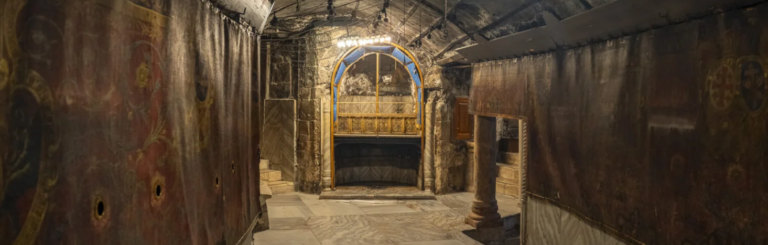 The grotto before the work
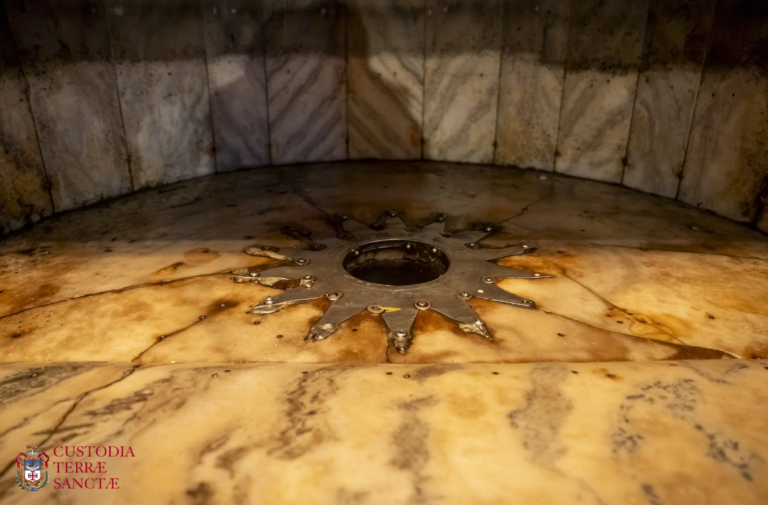 The silver star, included in the restoration
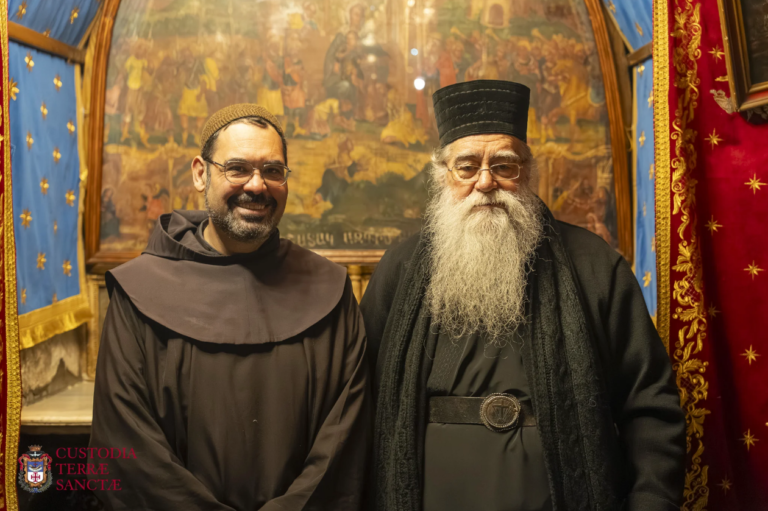 The three guardian Churches made the announcement together
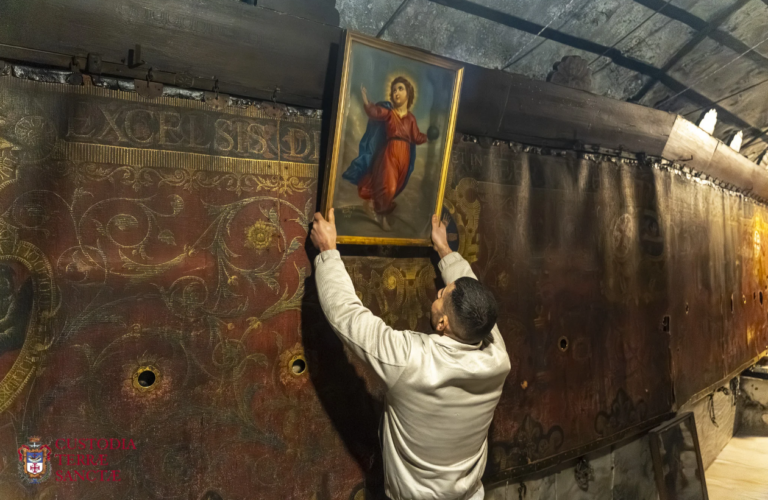 The artworks hanging in the grotto
The Church of the Nativity
Built over a grotto, standing since Justinian
About six miles south of Jerusalem, the basilica stands over a cave that Christians have pointed to as the place of Christ’s birth since the 2nd century. The Emperor Constantine began the church in 326. An unnamed pilgrim from Bordeaux found it already in use in 333, and it was dedicated on May 31, 339. It burned during the Samaritan revolts, around 529–531, and the Emperor Justinian rebuilt it. That building is the one still standing, making it one of the oldest churches in the world still in use. Tree-ring dating puts its wooden beams between 545 and 665.
You go in through the Door of Humility, about 31 inches wide and 51 inches high, so everyone has to bow down to enter. The doorway was made smaller at least twice, once by the Crusaders and once under the Ottomans. Sources don’t agree on who did it or why: some say for defense, others to keep people from riding in on horseback or bringing in animals. You can still see the top of the great Byzantine door and the bricked-up Crusader arch above it.
The grotto itself is about 40 feet long and just over 10 feet wide. A fourteen-pointed silver star is set in the marble floor, beneath the Altar of the Nativity, with this inscription: Hic de Virgine Maria Iesus Christus natus est: here, of the Virgin Mary, Jesus Christ was born. The Franciscans set a new one in 1717; it disappeared one night in 1847, and the Ottoman government had one set back in the early 1850s; nothing proves it's the same one (see the silver star). Fifteen silver lamps surround it, shared among the three communities: six for the Greek Orthodox, four for the Catholics, five for the Armenians. A few steps away, the Altar of the Manger and the Altar of the Adoration of the Magi are served by the Franciscans.
There’s an old story about this church. In 614, the Persians destroyed many churches in the Holy Land, but not this one. The story goes that they stopped in front of the mosaic on the front of the church, which showed the Wise Men in Persian clothes. That the church was spared is a fact. The explanation first shows up two centuries later, in a text from a 9th-century church council in Jerusalem. That doesn’t make it untrue: it’s how people remembered it, and it has become part of the place.
Crusader mosaics from the 12th century survive in fragments; two mosaicists are named, Ephraim and Basil. And the floor has wooden trapdoors that reveal, beneath, part of the original Constantinian mosaic.
The building was inscribed as a UNESCO World Heritage Site on June 29, 2012, under criteria (iv) and (vi), as "Birthplace of Jesus: Church of the Nativity and the Pilgrimage Route, Bethlehem," the first property inscribed for Palestine. It was simultaneously listed as in danger, because of water leaks, and only came off that list on July 2, 2019, once the roof had been redone. UNESCO listing.
The restoration, begun on September 15, 2013, covered about 17,500 square feet of lead roofing, the 42 wooden windows, about 1,350 square feet of wall mosaics, some 36,000 square feet of interior plaster, 33,000 square feet of façades and 48 of the 50 columns. Less than 8% of the roof trusses had to be replaced, with old timber from Italian churches. The same firm from Prato is now due to work on the grotto.
The silver star
Fourteen points, and many unknowns
It’s the only object in the world that claims to mark the exact spot. A fourteen-pointed silver star, set flat in the marble floor of the cave beneath the Altar of the Nativity, with a round opening in the center onto the bare rock. Around it, in Latin: Hic de Virgine Maria Iesus Christus natus est, “Here Jesus Christ was born of the Virgin Mary.”
You’ll read everywhere that the Franciscans put it there in 1717. That’s true, and it’s about all we know. The rest of this section sorts out what’s known and what isn’t, because on this subject, a lot of what you read elsewhere is stated with more confidence than the sources allow.
The place was already marked, and by a star, more than a century earlier. The Franciscan Bernardino Amico, guardian of the Holy Sepulchre in 1596 and resident in Bethlehem the following year, describes in his Trattato delle piante et immagini de sacri edifizi di Terra Santa a floor of fine marbles in which a star is carved whose rays are flush with the pavement, with a circle hollowed at the center and, in that circle, a serpentine stone set "for ornament and as a sign." Two consequences: the star shape and the central opening don't date from 1717; they repeat an earlier arrangement; and the Custody is right to write that the Latins set a new star in 1717. Amico's passage; we weren't able to read the original edition.
And that's where our knowledge stops: we don't know who wanted the 1717 star. No named custos, no donor, no king, no embassy, no confraternity. No workshop, no silversmith, no city of manufacture. No deed, no chronicle, no firman recording its installation. The silence is all the more striking because it's the Franciscans themselves, a party to it and keepers of the archives, who would have every interest in documenting the gesture: their own publications limit themselves to "the Latins placed it in 1717." All that can be said of the context is that the date falls in the window when the Latins were in a strong position: rights to the shrine recovered in 1690, lost in 1757. No source makes the connection: it's a coincidence of dates, not an explanation.
Why fourteen points? The number is a fact, but its meaning is an interpretation, and there are at least two. The most common one links it to the three sets of fourteen generations at the start of Matthew’s Gospel: from Abraham to David, from David to the Exile, from the Exile to Christ. The other links it to the fourteen Stations of the Cross. Neither has a source from the time, and no one has studied the star closely enough to settle it. The first idea is a beautiful one: it would make the star not just a marker but a count of all the generations it took to get here. But it’s an interpretation, not a proven intention.
It disappeared one night in 1847, in October according to most accounts. The texts that name a culprit all do so from one side only and contradict each other; no investigation and no neutral document has settled it, and local sources speak of a "mysterious" removal. So we won't name anyone. What is established is what followed: the affair fed the European quarrels over the holy places (see the Status Quo), a firman confirmed the division in 1852, and the Ottoman government had a silver star set back with its Latin inscription: in 1853 according to most sources, in 1856 according to a local history of Bethlehem.
And it's probably not the same one. No text says the stolen star was found, returned or recovered. A local history writes, on the contrary, that a new star was made to replace the one that had been stolen. And a Franciscan source specifies that the sultan had it set back "but with a Latin inscription": you don't specify the inscription of an object you're simply putting back in place. The English word used everywhere, replaced, means both "put back" and "substituted," and through that ambiguity "the 1717 star" has come to refer, in thousands of texts, to an object that may never have made it through the 19th century. So we write: a star was set in 1717, a star is in place today, and nothing proves it's the same one.
Fifteen silver lamps surround it, and their division sums up the life of the place: six for the Greek Orthodox, four for the Catholics, five for the Armenians. The altar above it belongs to the Orthodox and the Armenians; the Altar of the Manger, a few steps away, is served by the Franciscans. It's also on this star that the Latin Patriarch lays the Child on Christmas night, before he's carried to the manger.
One last point, and it's current: the star is named in the scope of the restoration announced on January 23, 2026: the rock, the marble floors, the columns, the decoration, and the star. It will be the first time in centuries that anyone looks at it closely. It's not impossible that this restoration will answer the question everything above leaves open.
One last thought, since it’s what this whole site is about. Our nativity scenes show a scene: a stable, straw, animals, a family, visitors. The place itself shows none of that. It shows a silver star in a stone floor, under a ceiling blackened by lamp smoke. Every nativity scene in the world lives in the space between the two: everything we’ve built in our imaginations around a spot that, in person, is simply a marker you can touch.
Those who keep these places
Friars, and eight centuries of custody
The Custody of the Holy Land is a community of Franciscan friars. It describes itself as a community “which, living in the Holy Land, preserves, studies and makes welcoming the Places of the origin of the Christian faith.” They aren’t museum curators, and it isn’t a job. They’re friars under vows, and what they do has a name: custodire, to keep watch over. The Custody and its history.
The story starts early. The first friars arrived in 1217, in Saint Francis's lifetime, led by Brother Elias of Cortona. Francis himself left for the East and met the sultan al-Malik al-Kamil at Damietta in 1219. The Custody was formally established at the chapter of Pisa in 1263. After the fall of Acre in 1291, the friars withdrew to Cyprus; they came back.
The legal title came next, and it came from Naples. In 1333, Brother Roger Guérin of Aquitaine obtained the Cenacle from the sultan, purchased thanks to Robert of Anjou, King of Naples, and his wife Sancia of Majorca, who had a friary built on Mount Zion. On November 21, 1342, Pope Clement VI approved the undertaking with two bulls, Gratias agimus and Nuper carissimae, and set out the arrangements for the new entity: the friars may reside permanently at the Holy Sepulchre and celebrate there. That's where the Custody still holds its mandate today. The friars settled in Bethlehem, next to the basilica, in 1347.
The first Statutes of the Holy Land, in 1377, limited the community to twenty religious serving the holy places, and spelled out their task: "to ensure the liturgical life in the Shrines" and assist pilgrims. Six and a half centuries later, it's still the same definition. In between there were expulsions (the Cenacle lost in 1552, the 1757 Ottoman firman that stripped them of much of their rights at the Nativity and the Holy Sepulchre) and a headquarters, Saint Saviour's friary in Jerusalem, acquired in 1560, which still is.
Today, the superior bears the title of Custos of the Holy Land and Guardian of Mount Zion. Father Francesco Ielpo, the 169th Custos, was confirmed by Pope Leo XIV on June 24, 2025, succeeding Francesco Patton. At his appointment, he spoke of "the enormous disproportion between my miserable person and the task asked of me." The Custody covers eight territories: Israel, Palestine, Jordan, Syria, Lebanon, Egypt, Cyprus and Rhodes.
And it doesn't just keep stones. In 2025, L'Osservatore Romano counted 1,465 employees, 558 apartments rented at token prices in Jerusalem and 68 in Bethlehem, 544 scholarships, and schools in Jerusalem, Bethlehem, Jericho, Cana, Haifa, Nazareth, Ramleh, Amman and Nicosia. The friars call the local Christians the "living stones," and say they share their life with them.
On what keeps them going, it's better to quote than summarize. "For us, loving this Land means loving Jesus. And we cannot think of Jesus without loving His Land." On welcoming pilgrims, the Custody writes that members of its Curia and the friars assigned to the task have welcomed thousands of pilgrims at Saint Saviour's, "explaining the reality of the Custody, its work in the Holy Land and passing on the Grace of the Holy Places, where the Christian spiritual roots are." The Curia and the Custos. And on what would happen if they stopped: "a holy place without continuous prayer would cease to be a holy place." Terre Sainte Magazine, November 20, 2025.
The noon procession
Four stations, in Latin, since at least 1623
Here’s what that looks like on an ordinary day. Monday through Saturday at noon, the friar on duty that week, two companions and an altar server with incense go down into the grotto of the Nativity. Pilgrims follow them, each holding a lit candle.
The procession makes four stations. First the Altar of the Star, the place of the birth; then the Holy Manger; then the Altar of the Three Magi; and a fourth station that varies, chosen among six: Saint Joseph, the Holy Innocents, the tomb of Saint Jerome, that of Saint Paula and Saint Eustochium, that of Saint Eusebius, or the altar of Saint Catherine, on Saturdays. At each station, a hymn, incense, an Our Father, a Hail Mary, a Glory Be. The singing is in Latin; the prayers may be said in other languages.
Brother Tommaso Obicini da Novara described this procession in 1623, and it’s probably even older. So it has happened every day for at least four centuries, whether one or two pilgrims show up on a winter morning or three hundred on December 25. It’s the clearest answer to the question of what these friars are doing there. The Custody’s account.
Two notes: the Custody page with this schedule isn’t dated, and schedules change, so call the Bethlehem parish before planning your day around it. And we don’t know what happens on Sundays: the source just says “Monday to Saturday.”
The Status Quo and the three Christmases
Why Christmas falls three times there
Three communities share the basilica: the Greek Orthodox Patriarchate of Jerusalem, the Armenian Apostolic Patriarchate and the Custody of the Holy Land. The sharing isn't a courteous arrangement: it's a legal regime, the Status Quo, which freezes the situation as it was in 1757, confirmed by an Ottoman firman in 1852, then guaranteed by the Treaty of Berlin in 1878. It says who owns what, who celebrates when, and even who has the right to sweep which step.
The trigger is well known: the disappearance of the silver star, in October 1847, in an already tense period. The incident belongs to the series of European quarrels over the holy places that preceded the Crimean War. You'll often read that it started the war; that's going faster than the sources.
For a visitor, the most visible result is that Christmas is celebrated there three times.
The Latins (Catholics) celebrate on December 25. The Greek Orthodox, Copts, Syriacs and Ethiopians celebrate on January 6 and 7: the Greek Orthodox Patriarchate of Jerusalem kept the Julian calendar when the Church of Greece moved to the Gregorian, and kept it precisely so as not to disturb the 1852 Status Quo. The Armenians celebrate on January 18 and 19: they never adopted December 25 and celebrate the Nativity, the Baptism and the Epiphany on the same day, as all of Christendom did before the 4th century; the shift from January 6 to 18 comes, again, from the Julian calendar.
The ceremonies are different too. Catholics carry a figure of the Christ Child and lay it in the manger. Armenians don’t lay down a child: they dip a cross into holy water, because they celebrate Christ’s Baptism on the same day. In the same cave, three weeks apart, two ways of saying the same thing.
You can see the Status Quo at work down to the minute. On December 25, Catholics celebrate Mass in the cave nonstop from midnight to 5 p.m., with two breaks: one for the Patriarch’s ceremony, and one from 5 to 6:30 a.m. for the Greek Orthodox service. Since Ottoman times, a soldier has stood guard near the Altar of the Nativity to prevent incidents. It’s less quaint than it sounds: it’s what lets three churches share one holy place without fighting over it.
Christmas night in Bethlehem
The Child carried to the grotto after midnight
On December 24, the Latin Patriarch of Jerusalem comes down to Bethlehem. In the morning, he receives the faithful at the Patriarchate; the procession then sets off, stops at the Mar Elias monastery, and is welcomed at Rachel's Tomb at 1 p.m. by the Latin parish priests. It goes up Star Street while some twenty scout troops march, and the mayor receives him in Manger Square. The solemn entrance into the basilica and then Saint Catherine's Church takes place at 1:30 p.m., followed by First Vespers.
The day goes on: 4 p.m., the daily procession to the grotto, the same as every day; 9 p.m., the doors of Saint Catherine's open, and close as soon as the church is full; 11:30 p.m., the Office of Readings; midnight, Mass.
After the Gospel comes the moment families around the world imitate at home: the bells ring, the statue of the Christ Child is unveiled, and the Patriarch himself carries it in procession down to the cave. He lays it on the silver star, then the deacon wraps it in swaddling clothes and carries it to the manger. It stays there until January 4. On January 6 at 3:30 p.m., a solemn procession goes down to honor it with gold, frankincense and myrrh.
This is the 2025–2026 schedule, published by the Custody’s Christian Information Center. It’s much the same every year, but a new one comes out each December, and that’s the one to go by. Program of celebrations.
Shepherds' Field
A chapel shaped like a tent
In Beit Sahour, east of Bethlehem, two shrines mark the place where the angels appeared to the shepherds, so make sure you know which one you’re heading to: a Catholic site run by the Franciscans, or the Greek Orthodox Deir el-Rawat monastery. We don’t describe the second one, because we found no reliable source on what you can see there.
The Catholic land was bought by the Franciscans between 1889 and 1906. The Chapel of the Angels, completed in 1953, is by Antonio Barluzzi, the architect who built half the shrines of the Holy Land in the 20th century. He gave it five apses imitating a nomad's tent, in gray, and had the angel's words to the shepherds inscribed in gold letters. A cave opens behind it.
Digs led by the Franciscan archaeologist Virgilio Corbo uncovered caves people lived in during the time of Herod and the Romans, ancient olive presses, and a monastery built in the late 300s, enlarged in the 500s, destroyed by the Persians in 614 and never used again. In other words, a small community really did live there at the time of Christ’s birth, and monks were already praying there three centuries later.
In Bethlehem itself, the Milk Grotto is kept by the Custody. It has been venerated since the 4th century; a first building went up in 385, Pope Gregory XI recognized it in 1375, the Franciscans built the present church in 1872 and a modern chapel was added in 2007. Tradition says a drop of the Virgin's milk fell on the stone during the flight into Egypt and turned it white. People pray there to Our Lady of the Milk for the gift of a child; Christians and Muslims come, and the walls are covered with framed letters and photos of babies sent from all over the world.
Finally, beneath Saint Catherine's Church lies the network of Saint Jerome's caves: the crypt of Saint Joseph, the chapel of the Holy Innocents, the tomb of Saint Paula (who died in 404), her daughter Eustochium and Eusebius of Cremona, and the room known as Jerome's study. Jerome settled in Bethlehem in 386 and spent more than a third of a century there translating the Bible. Each of these chapels has its altar, and Mass is celebrated there.
Jerusalem
The Holy Sepulchre, and a floor being excavated since 2022
It isn’t a Nativity site, but it follows the same rules and is usually part of the same trip. The Holy Sepulchre is shared by the same communities, under the same 1852 Status Quo.
A rare project is under way: on March 14, 2022, work began to restore the floor, along with the first full archaeological dig under the basilica’s floor, led by Sapienza University of Rome. All three communities had to agree to it. One detail says everything about the Status Quo: the project leader warned from the start that most of what they find will probably have to be covered back up, as the rules require.
The Custody is also present at Gethsemane, whose grotto it has held since 1392, and at the Tomb of the Virgin, obtained in 1363.
Nazareth and Ein Karem
Where the angel came, and the Madonnas of the world
The Christmas story begins in Nazareth, nine months earlier. The Basilica of the Annunciation, designed by the Italian architect Giovanni Muzio, was built from 1960 to 1969 and consecrated in 1969. Its lower church holds the Grotto of the Annunciation, whose altar is inscribed Verbum caro hic factum est, “Here the Word was made flesh.” The key word is hic, “here,” the same word as on the star in Bethlehem.
What stays with you as you walk through the courtyard are the images of Mary given by countries around the world: mosaics and a few ceramic panels on the courtyard walls and in the upper church, each showing how one nation honors Our Lady: the Candelaria of the Canary Islands, Montserrat, Our Lady of the Forsaken of Valencia, Our Lady of Guadalupe of Extremadura, and dozens more, including the United States. It’s exactly what nativity scenes do, but in reverse: instead of each country setting the scene its own way at home, each country brought its own image of Mary to the same spot.
Ein Karem, in the hills west of Jerusalem, is where tradition places the Visitation and the birth of John the Baptist. We couldn’t confirm the details usually given about these two shrines, and we’d rather say nothing than copy what others say. If you know them, write to us.
Where to see nativity scenes
Two hundred nativity scenes from around the world at the Salesians'
It may seem like an odd question (going to see a nativity scene in the very place it shows), but there are good answers.
The first is the nativity in the grotto itself, which is part of the liturgy, not an exhibit. The Christ Child figure is carried there on Christmas night and stays until January 4 (see above). It’s the only nativity in the world set up in the very place it depicts.
The second is a museum. Bethlehem's International Nativity Museum, in the Salesian convent complex, on a street parallel to Star Street, displays more than two hundred nativity scenes from around the world. Admission €4 (20 shekels), €3 reduced, flexible hours and by reservation. The Bethlehem municipality presents it on its website, but without a date: check that it's open before making the trip.
The third is all around you: in the workshops and shops of Bethlehem and Beit Sahour, where the olive-wood nativity sets found in homes across Europe and America are made. More on that in the next section.
Olive wood and mother-of-pearl
A Bethlehem craft since the 15th century
If you have an olive-wood nativity set at home, it very likely came from here. According to the director of the Palestinian Museum, Christians in the Holy Land have carved olive wood since Byzantine times, and the craft took off in the late 1800s as pilgrims began arriving in larger numbers.
Mother-of-pearl has an even more precise history, and it's Franciscan: friars from Italy introduced it to Bethlehem in the 15th century. Bethlehem women's work in mother-of-pearl is attested at least since the 17th. In 1727, the traveler Richard Pococke described wooden crosses and rosaries inlaid with mother-of-pearl, and models of the holy places. In the early 1850s, two brothers, Giries and Ibrahim Mansur, showed Palestinian mother-of-pearl objects in the West for the first time, at a world's fair in New York. The material once came from Red Sea oysters; since 2007, it has come mostly from Australia, California, New Zealand and Brazil.
Beit Sahour was named a World Craft City for 2020.
We won’t give numbers for the whole industry, because the totals floating around can’t be verified. What we can give are names and dates. Attalah Zacharia’s workshop, founded in 1960, has gone from twenty-five employees to ten and lost three-quarters of its business since 2023. The Tabash family business, nearly a hundred years old, supports about twenty-five families, more than a hundred people. In December 2024, the workshops surveyed had cut their staff in half and were losing money. A nativity set bought here isn’t just a souvenir: it’s how a five-hundred-year-old craft keeps going. Many US parishes host Bethlehem olive-wood sales at Christmas, a way to help from home.
The holy places today
What we know, and as of when
This section goes out of date fastest, so we give only facts, each with its date.
Christmas 2023 and Christmas 2024. In late November 2023, Christian leaders and the Bethlehem municipality canceled public festivities (the tree in Manger Square, the parades), judging it "not appropriate" to hold them during the war in Gaza. Religious services, however, went on: Midnight Mass was celebrated both years by Cardinal Pizzaballa. The grotto never stopped being served.
Christmas 2025. After the October 2025 ceasefire, public celebrations returned. The tree in Manger Square was lit on December 6, 2025, before thousands of people, mostly residents; on December 24, the square was full, the scouts marched, and Midnight Mass took place at Saint Catherine's. The mayor of Bethlehem said then: "After two years of silence, we believe we've rekindled the spirit of Christmas." He also pointed out that 85% of the town's families depend, directly or not, on pilgrimage.
March 2026. The situation turned again. On March 1, 2026, airspace was closed and groups of pilgrims found themselves stranded; the Custody came to their aid. On March 20, 2026, a journalist on the ground wrote that almost all of Bethlehem's hotels, restaurants and souvenir shops are closed. Figures cited for mid-2025 put unemployment in the town at 31%, where tourism traditionally accounts for 70% of the economy.
What we don’t know. Our most recent reliable source is from March 20, 2026, and we’re writing this in the fall. So we can’t tell you how things stand right now with hotels, flights or getting into Bethlehem. Before any trip, ask the people on the ground: the Custody of the Holy Land, or your diocese.
One thing hasn’t changed. Through these three years, the noon procession kept going down into the grotto every day, with or without pilgrims. It may be the one sentence on this page that stays true no matter what happens.