STYLE
The Church Nativity
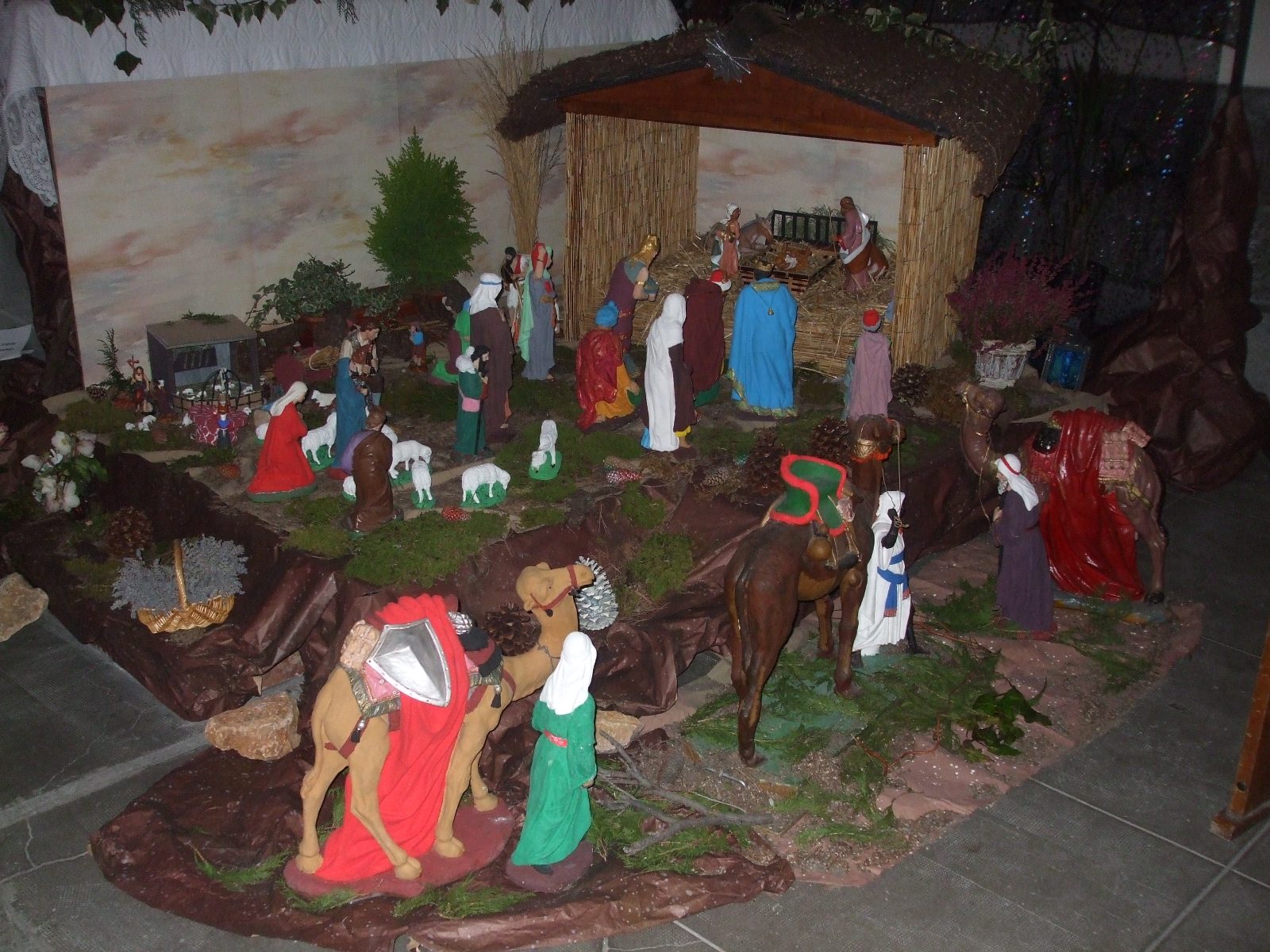
A church nativity is more than a home nativity made bigger. Hundreds of people see it from a distance as they move through, in a building with its own safety rules and its own rhythm of worship. The rules are different there, and nearly all of them point toward keeping it simple.
Designing for distance
A home nativity is seen from three feet away. A church nativity is seen first from the back of the church, fifty or sixty-five feet away, then up close by people who walk up to it. It has to work both ways, and the view from far away comes first.
In practice:
- The overall shape has to be clear in one second. One main shape, a dark mass, a point of light. If you can’t tell from a distance where the stable is, it isn’t working.
- Details are a bonus, never the main thing. They reward people who come close, but they don’t carry the scene.
- Contrasts need to be strong. Subtle aging effects disappear at thirty feet.
- Use a few large pieces. A village of thirty houses turns into a blur; three well-placed shapes stand out.
Scale and placement
Figures from 12 inches up to life-size are standard. Below 8 inches, the scene gets lost in the size of the building.
Get the pastor or parish team to agree on the spot ahead of time. A few general guidelines:
- It shouldn’t hide the altar, the ambo (the reading stand) or the tabernacle, or get in the way during Mass.
- A side chapel or side aisle works better than the sanctuary: visitors can stop there without walking through the area where Mass is celebrated.
- Raise it 16 to 24 inches so it stays visible over people’s heads.
- Leave open space in front, where someone can kneel or hold up a child.
Visitor flow
This is what churches most often forget to plan for. A good nativity draws people in, including people who don’t come to church the rest of the year.
- Plan for people to walk past in one direction instead of crowding in from the front.
- Expect kids to want to touch. A low barrier works better than a sign, and a nativity that’s completely out of reach misses part of the point.
- Think about a five-year-old’s eye level: about three feet. Anything they can’t see from there, half your visitors won’t see.
- A small label naming any less familiar figures helps more than you’d think, especially for visitors who don’t know the Provençal tradition or wherever your figures come from.
Safety
A church is a public gathering place. The exact rules vary by state, city and diocese, so check locally, but four points apply everywhere:
- No open flames. LED candles only, including any votive candles nearby.
- Use fire-rated materials wherever you can. Straw, dry hay, cardboard and bare foam are the most common materials and the most flammable; some dioceses and fire marshals ban them or require a flame-retardant treatment.
- Wiring that meets code, very low voltage for anything people can reach, UL-listed power supplies, and no cords across a walkway.
- Nothing can block an emergency exit or hide a fire extinguisher or exit sign.
Get the location approved by whoever is in charge of building safety before you build, not after.
Restraint as a method
A church nativity has a job a home nativity doesn’t: it helps people pray, and they didn’t come to admire a model.
Here’s what that means, and it fits right in with designing for distance:
- No showy effects for their own sake, like visible machinery, a noisy fountain or changing lights. They grab attention and hold on to it.
- No figures of current celebrities or inside jokes, except in traditions where that’s the custom, like Naples.
- Everything should lead the eye to the manger: paths, light, the way the figures are placed. It’s the same idea as in a living-room nativity, just applied more strictly. See everything converges.
The liturgical calendar
The most common practice:
- Set up at the start of Advent, with the manger empty.
- The Baby Jesus is placed in the manger at Midnight Mass (the Christmas Mass during the Night), often carried in procession by a child.
- The Wise Men move forward until Epiphany.
- The nativity stays up until Candlemas, February 2, the feast of the Presentation and the traditional end of the Christmas cycle. Many American parishes take it down after the Baptism of the Lord, which ends the Christmas season.
Taking it down on December 26, as some places do for convenience, cuts the story off just as it’s getting started.
A nativity for prayer
People don’t just look at a church nativity; they stop there to pray. A few simple choices help.
- Bless it. The priest usually blesses it when it’s set up or during the Christmas Mass during the Night, when the Child is placed in it. Many parishes also offer, during Advent, to bless the Christ Child figures from families’ nativities, as is done in Rome: see the blessing of the Bambinelli.
- Leave space in front of it. A bench or kneeler a few yards away, out of the line of traffic, invites people to sit instead of just filing past.
- Offer the words. A small sign with Saint Luke’s account and a short prayer helps people who don’t know what to say. Ideas on praying before the nativity.
- Welcome groups. Religious education classes, schools, senior living communities: set visiting times and have someone ready to tell the story. See explaining the nativity to kids.
- Votive candles, if you have any, should be well away from the scenery and supervised: see safety.
Practical organization
-
A team, not one person
Setting up a large nativity takes two to three days with several people. Put your team together in October, not at the end of November.
-
A photographed plan
Take photos of the finished setup from several angles. Next year, the person setting it up may not be the one who did it this year.
-
Numbered storage
Labeled bins, numbered pieces, and the setup plan in the first bin. Church nativity pieces are bulky and easy to lose.
-
A maintenance budget
Large figures chip and fabrics fade. Plan to repair one or two pieces a year instead of a full restoration every fifteen years.