SETTING UP
How to Set Up a Nativity Scene
Setting up a nativity happens in two stages. You plan it first, before you build any scenery, and you finish it at the very end by putting each figure in its place. A well-arranged nativity tells a story in motion: everyone is heading to the same place, each at their own pace. A poorly arranged one looks like a store shelf of figurines all facing you.
That said, there are countless ways to make a beautiful nativity, and no single right one. Take the ideas you like from this page. You don’t have to follow it to the letter.
This page follows the main ideas of the traditional Provençal crèche, but they work just as well for any nativity set: a family heirloom, a Fontanini or a Willow Tree set. Pick your starting point:
Got an old set with a broken figure? See how to fix and care for an old nativity set. Setting one up outside? See the outdoor nativity guide.
Before placing the first figure
Make these four decisions before you start placing figures:
The size of the figures
Tiny, 1½, 3 or 3½ inches, or the popular 5-inch size and up: this comes first, because it shapes everything else. The smaller the figures, the more characters, layers and movement you can fit in the same space. See figure sizes.
The viewing angle
A nativity on a shelf at eye level looks very different from one on the floor that kids look down on. Turn your figures based on where people will actually see them from. See lines of sight and groups.
The number of planes
One layer works well for a small nativity, and larger ones can have up to three. One well-done layer beats three half-empty ones. See the three planes.
Density
How many figures should you put out? Usually a few fewer than you’d like. Empty space says as much as the figures do. If your collection is overflowing, rotate figures from year to year instead of crowding them all in. See what spoils the effect.
The principle: everything converges
A nativity isn’t just a display of figures. It’s the moment a village hears the news and sets off. Every character is somewhere along that journey: some have arrived, some are on the way, and some haven’t heard yet.
If you remember only one thing: almost no figure should look out at the viewer. They look at the stable, or at what they’re doing. The viewer is watching the story, not part of it.
The three planes
-
The stable — where everyone is going
The Holy Family, the ox and donkey, and the angel above. One or two shepherds kneeling at the entrance, no more. It’s a small space, and crowding it ruins the scene. In a Provençal crèche, the ravi stands just outside, where everyone can see him.
-
The path — the journey
The procession stretches out in small groups with space between them: the drummer in front, the gift bearers, the blind man and his son, the families. Spread them out. Four figures spaced over 8 inches look like a journey. Eight figures bunched together look like a traffic jam.
-
The village — life goes on
The tradespeople are at work: the miller at the mill, the washerwoman at the washhouse, the baker at the oven, the pétanque players on the square. They haven’t left yet, or they won’t. Having some villagers carry on with their day is what makes the scene feel real.
In a Provençal crèche, the boumian has a place of his own, outside the three layers: off to the side, often with his back to the village. He belongs on the edges, and putting him in the procession takes away his meaning.
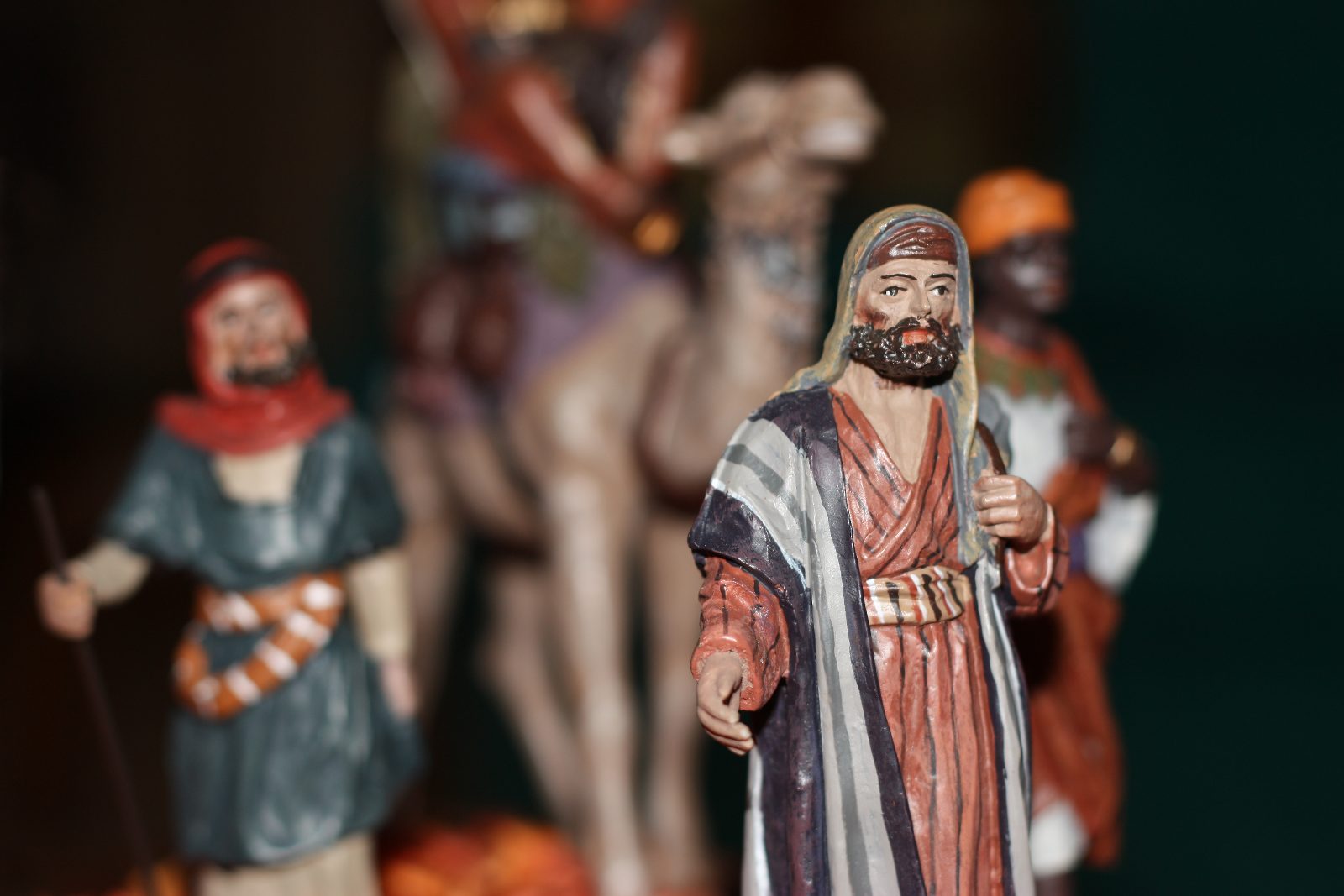
Lines of sight and groups
A few simple tweaks make a big difference:
- Point the feet, then check the gaze. Turn each figure the way it’s walking, then crouch down to the nativity’s level. It should be looking at the stable, at its neighbor or at its work. Never at nothing.
- Group in odd numbers. Three figures together look like a group, two look like a couple, and four look like a line. Stick with threes and fives.
- Make them interact. Two figures facing each other ⅜ inch apart are talking. The same two figures 1½ inches apart, turned toward the stable, are walking. Same pair, two different stories.
- Vary the height. Put one figure on a step and another lower down, and the group comes alive. Plan for it when you build the terrain.
The nativity calendar
A nativity doesn’t have to be set up once in early December and left alone. Traditionally it changes through the season, and that’s what makes it so special for kids.
| Date | What happens |
|---|---|
| December 4 — Saint Barbara (a Provençal custom) | Sow the wheat in three saucers. It joins the nativity at Christmas. |
| First Sunday of Advent | Set up the scenery and the village figures. The stable stays empty: no Child, and depending on the family, no Mary and Joseph either. |
| Through Advent | The figures move a little closer to the stable each day. Mary and Joseph are on the road too. |
| Christmas Eve | The Child is laid in the manger, traditionally by the youngest in the house. The shepherds arrive. This is the moment of the nativity. |
| December 25 | The Three Wise Men appear at the farthest point of the nativity. |
| Epiphany (January 6, or the Sunday between January 2 and 8 in the U.S.) | The Wise Men finally reach the stable and present their gifts. |
| February 2 — Candlemas | In the Provençal tradition, this is when the nativity comes down. |
You don’t have to do all of this. But placing Baby Jesus on Christmas Eve and moving the Wise Men each day are the two traditions that turn a decoration into a family ritual, and they cost nothing.
The journey of the Three Wise Men
The Wise Men travel for twelve days, from December 25 to January 6. On a 5-foot nativity, that’s about 4 inches a day. On a 20-inch one, about an inch and a quarter.
A few tips to make it believable:
- Hide them at least once, behind a hill, some trees or a wall. Having them reappear is more fun than a straight march.
- Keep them together but not in a row: one in front, two behind, never side by side like they’re posing for a photo.
- The camel and the servant stay behind the whole way, and stop at a distance from the stable.
- On Epiphany, have them kneel if your figures allow it. Many sets offer the Kings both standing and kneeling. Otherwise, turn them to face the manger.
What spoils the effect
- The lineup. Figures spaced evenly along a path like fence posts. Break it up: two together, a gap, three, a bigger gap.
- Facing the audience. Every figure turned toward you. You’re not the subject of the scene.
- The crowd. Thirty figures on 16 inches of space. If you have lots of figures and little room, rotate them from year to year. It keeps things interesting for everyone, including you.
- A worker with no workplace. A knife grinder in the middle of a field. Every tradesperson needs a spot that makes sense. See the trades.
- Floating figures. A base sitting on top of the moss where you can see it. Press it in a little, or hide the edge with some soil and greenery.
- The Wise Men at the manger on Christmas Eve. They’re twelve days early, and you miss out on the best tradition of the season.
Nobody gets it perfect the first time, and that’s fine. You get better at it over the years, not from a manual. Many families say it’s their favorite part: with the scenery in place, you take your time placing each figure, step back, and try again. It’s never quite the same from one year to the next, and that’s how it should be. Your nativity can grow and change with you.