SANTONS
Collecting Santons
Once you pass thirty or so pieces, your nativity becomes a collection, and new questions come up: Where did this santon come from? How old is it? How do I take care of it? What makes it valuable? This page gives you what you need to judge for yourself, no expertise required.
What do people collect?
There are several ways to build a collection, and it’s better to pick one than to buy at random.
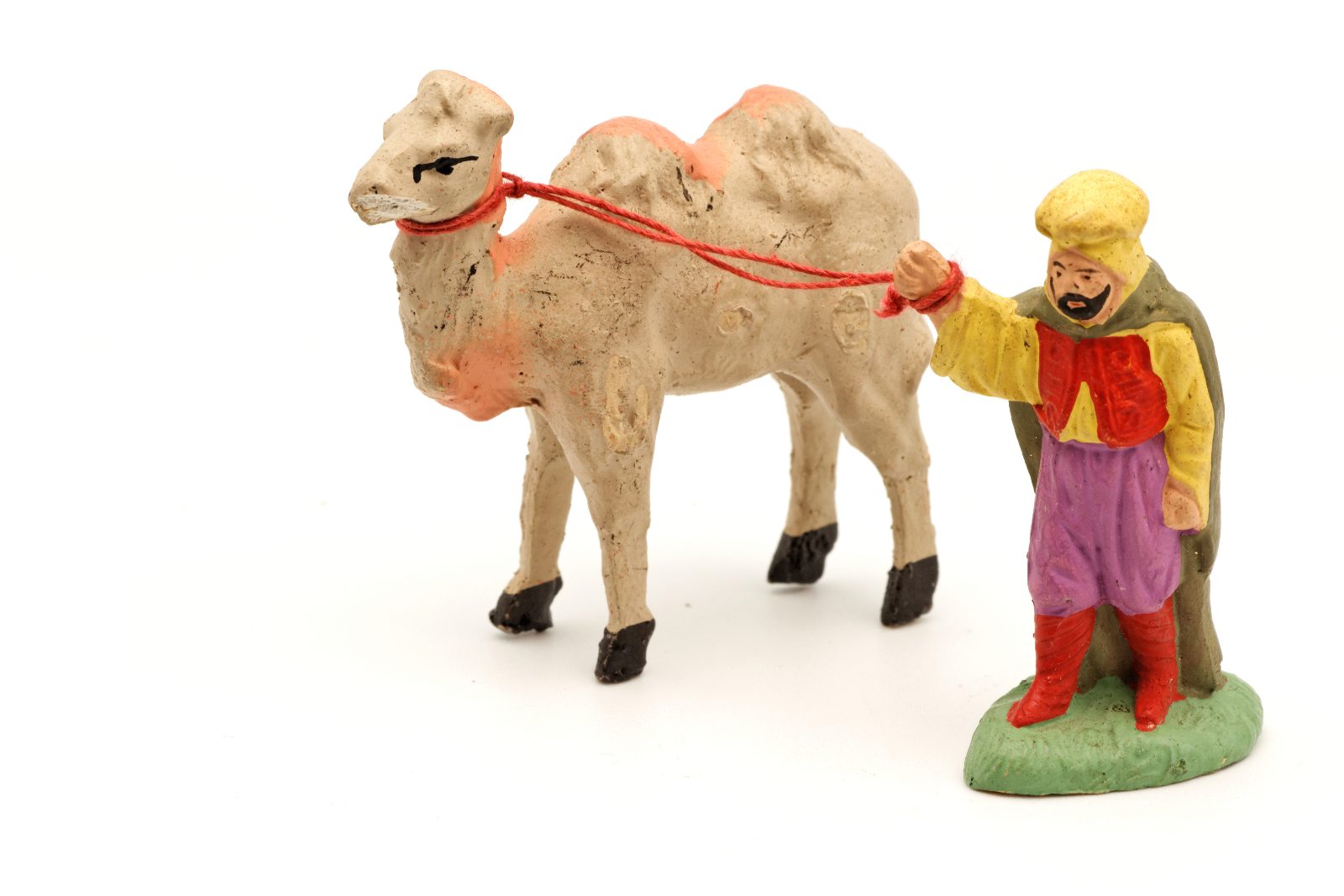
- By workshop: the most common approach. You follow one santon maker and fill out their line over the years. The big advantage: matching size and style are guaranteed.
- By character: the same ravi as made by ten different workshops. A themed collection, often displayed separately from the nativity.
- By era: antique santons from the 19th or early 20th century. The most challenging kind, and the one that takes the most know-how.
- By tradition: a Provençal santon, a Neapolitan figure, a caganer, a szopka figure, a Mexican nacimiento piece. More for comparing than for building a nativity.
- By need: simply whatever your nativity needs. That’s as good a reason as any.
The base test
Before you look for marks or signatures, check the material. You can see it in the same place on every piece: under the base, which is usually left unpainted. It’s the first thing a collector checks in a box of flea-market santons, because it quickly rules out a lot of possibilities.
- Terracotta: fine grain, hard surface, red, ochre or white depending on the clay; the piece rings clear. This is the santon of Provence as the term is meant.
- Unfired clay: same color, but the surface scratches with a fingernail and leaves clay dust. Dried and painted without firing: the case of many old santibelli, and of more recent souvenir figurines.
- Plaster: bright white, porous, lighter than it looks, edges chip. Very common in production from the first half of the 20th century.
- Resin: smooth, even surface, sometimes a fine mold line along the side, base often hollow. Industrial production, generally of no collecting interest.
Here’s a dating clue few guides mention: the color of the base. Several workshops changed it over the decades, and collectors use it to date a piece within ten or twenty years. Always photograph the bottom: that’s where half the information is.
Appraising, buying, selling
There’s no published price guide for santons. Prices on sites like eBay or Facebook Marketplace aren’t real market values. They’re asking prices, often from sellers who don’t know what they have.
The only solid benchmark is public auction. On November 30, 2023, in Marseille, a private collection of more than twenty-four hundred pieces assembled by the santon maker Marcel Carbonel was sold at auction: about three hundred lots, church santons estimated at up to €3,000, 18th-century Neapolitan pieces, and names that show the market’s hierarchy: Jean-Louis Lagnel, Father César Sumien, Thérèse Neveu, Liliane Guiomar. Results of this kind of sale can be looked up and are the only honest yardstick a collector has.
To get a piece appraised, you have three options, from most to least useful: an auctioneer in the Marseille area, who sees these pieces all the time (in the U.S., an auction house that handles European decorative arts is the closest thing); a working santon maker, who can often recognize a mold or a maker’s hand even without a mark; or a collectors’ forum, where people are surprisingly good at identifying pieces from clear photos of the front, side and bottom.
What makes a piece more valuable. First, a known maker. Then, how early it was cast: a figure made during its creator’s lifetime is worth more than one made thirty years later from the same mold by a successor. Next comes rarity: minor characters made in small numbers are often harder to find than the Holy Family. Condition comes after that, and a glued santon holds its value much better than a repainted one. See also santon care.
Reading the marks
Turn the piece over. Under the base or on the back, you sometimes find:
| What you see | What it tells you |
|---|---|
| A name or initials incised | The mark was in the mold: it dates the model, not the casting |
| A stamp, inked or painted | Applied after firing; may vary over a studio’s life |
| A paper label | Often commercial, sometimes a retailer’s rather than the maker’s |
| Nothing at all | Very common, including on excellent pieces. No mark says nothing about quality |
No website can authenticate a mark. What you can do is photograph it and show it to a santon maker or an experienced collector. Most can recognize the workshops from their area at a glance.
Dating a piece
No single clue is enough. It’s the combination that counts.
-
The material
Unfired clay points to old or traditional craft production. Resin and industrially cast plaster are late.
-
Mold wear
Soft modeling, blurred folds, a barely readable face can indicate a late casting in a mold’s life, not necessarily an old piece. See the mold.
-
The paint
Matte, slightly powdery gouache is older than satin acrylic. Paint that flakes in small hard plates suggests an old coat.
-
The subjects
Some trades disappear from the repertoire, others appear. A santon showing a forgotten trade is generally older than a generic one.
-
The grime
Dirt lodged in the hollows, even and old, isn’t easy to fake. An object too clean for its apparent age may have been cleaned, or repainted.
Two things to watch for: a repainted piece loses much of its interest and value, and a piece repaired with super glue often has a permanent dark ring around the joint. Check the necks and wrists, where breaks usually happen. See repairing a break.
Santon or santibelli?
People mix these up at flea markets all the time, but the difference is easy once you know it.
Santibelli are polychrome plaster figures sold in the 19th century by Italian peddlers, often under a glass dome. The word comes from the Italian santi belli, “beautiful saints.” They’re objects of household devotion, not nativity figures.
| Santon | Santibelli | |
|---|---|---|
| Material | Clay, unfired or fired | Plaster |
| Weight | Dense for its size | Lighter, more crumbly |
| Subject | Nativity and village | Saints, Madonnas, single devotional subjects |
| Size | Small, made for a group | Often larger, made to stand alone |
| Display | Flat base, to stand | Often under a dome, on a pedestal |
Easy test: gently scratch a tiny spot under the base. Plaster is white and powdery, while fired clay is colored and hard.
What gives value
We don’t list prices, since they vary by country, market and year. But what drives value stays the same:
-
Condition
By far the most important factor. An undamaged piece is worth several times the same piece glued back together. Original paint, nothing missing, no repainting.
-
One of a kind versus series
A piece modeled by hand, not molded, belongs to another market: sculpture.
-
Rarity of the subject
A rare tradesperson is worth more than a shepherd, which every workshop has made by the thousands.
-
The studio
Some makers are in high demand. This depends more on the local market than anything else.
-
Completeness
A consistent set from the same studio and period is worth more than the sum of its pieces.
-
Provenance
Knowing where a piece came from and who owned it is what makes it a true collector’s item. More on that below.
Preserving a collection
The basics are in care and storage. Three things matter especially for collections:
- Light is the biggest enemy for pieces on display all year. Colors fade, red first, and the fabric on dressed santons fades even faster. Use a display case out of direct sunlight, or only display them seasonally.
- Steady humidity matters more than low humidity. It’s the ups and downs that weaken glued joints and make paint flake. A living room beats an attic or basement.
- Don’t restore a valuable piece yourself. A chip shows age, but a clumsy touch-up is permanent damage. For pieces that matter, go to a professional.
Documenting
This is what turns a bunch of figures into a real collection, and it only takes two minutes per piece.
Write one line per santon: the character, the maker if you know it, the size, the material, when and where you bought it, the price, the condition, and a note about who picked it and why.
Take one photo per piece, front and bottom (for the mark). And take a photo of each box when you pack up: it doubles as a visual inventory and a guide for next year.
Three reasons, and the last one is the one that really counts:
- A documented collection is insurable.
- It keeps you from buying duplicates, which happens fast once you pass fifty pieces.
- It can be passed down. A santon you know Grandma bought at the santon fair one winter is no longer just a figure. That’s what makes a family nativity different from a box of figurines.
Frequently asked questions
How much is an antique santon worth?
It depends on who made it and when it was cast, and there’s no published price guide. Asking prices online aren’t real market values. The only reliable guide is auction results: specialized sales in Marseille show the real range, from common pieces at a few euros to church santons estimated in the thousands.
My santons have no mark. Can they still be identified?
Often, yes. Many workshops never signed their pieces, and the mark isn’t the only clue. The material under the base, the base color, the paint colors, the way faces and hands are done, and the shape of the base are often enough to identify a maker. Take photos from the front, the side and especially the bottom, and share them on a collectors’ forum or with a santon maker.
Where can you sell a santon collection?
For a serious collection, a specialized auction gets the best results, because knowledgeable buyers bid against each other. For single, common pieces, online listings and local fairs are fine. Never sell a whole lot “as is” without having someone look at it first. That’s how rare pieces slip away.
Should you insure a santon collection?
Above a certain value, standard homeowners insurance won’t cover a collectible at its real worth, and it often caps coverage per item. In the U.S., ask your insurer about a scheduled personal property rider. Either way, start with a dated, photographed inventory listing where each piece came from and what you paid. It’s what you’ll be asked for after a loss, and when an estate is settled.
Does a santon from a closed studio gain value?
Not automatically. What matters is demand, which depends far more on the maker’s reputation than on the workshop closing. But a closing does freeze production: no more pieces can be made, so the rare ones stay rare for good.
Does a santon made outside Provence have collecting value?
Yes, and some are in high demand. Workshops outside southern France made quality nativity figures for decades, and collectors seek them out too. What has no collector value is the mass-produced resin figurine, wherever it’s made.